The jaw crusher is the oldest and most widespread machine in primary crushing. Its principle is simple — compressing material between a fixed jaw and a swing jaw — but it comes in two technologies whose behaviour differs sharply: single toggle and double toggle.
Understanding what separates them is understanding why one now dominates the market and the other remains reserved for specific applications.
The principle: compressing between two jaws
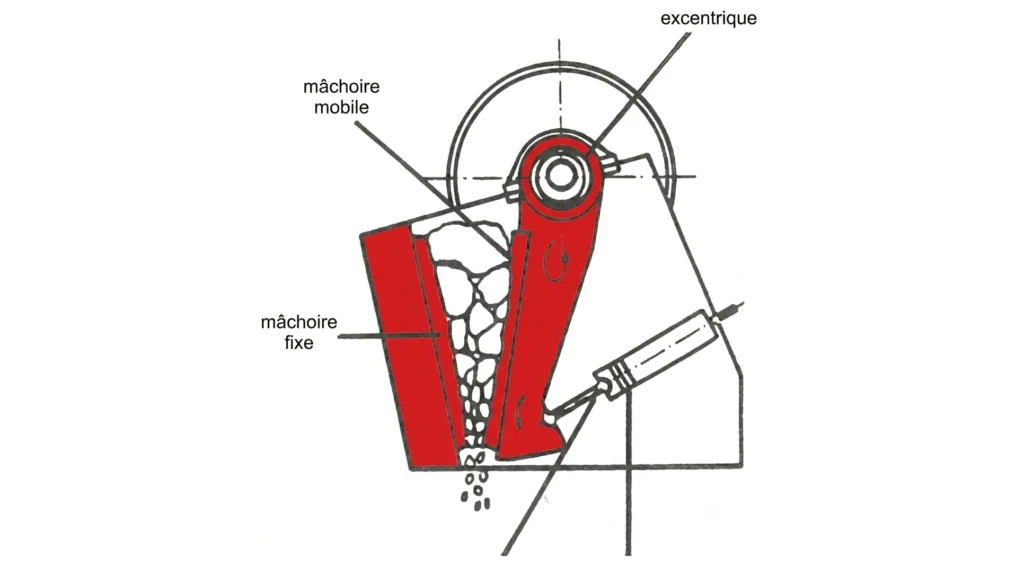
The material is compressed between two jaws, one fixed and one moving. The great majority of these machines have vertical jaws: the material then passes through the machine by gravity.
For specific needs there are also horizontal crushers, in which an apron conveyor moves the material through the machine. Crusher and conveyor form a single mechanical assembly.
Single toggle and double toggle
The single-toggle crusher
Also called a single-toggle-plate crusher, it is today the most common configuration.
The swing jaw is connected at its upper end to an eccentric shaft, while its lower end rests on an articulated toggle plate. The result is a reciprocating movement of limited amplitude, to which is added a friction effect between the jaw and the material.
The swing jaw thus describes an alternating slide: upwards during the opening phase, downwards during closing, over a distance close to twice the eccentricity of the shaft.
The double-toggle crusher
Derived from the Blake machine, patented in 1858, the double-toggle crusher — or double toggle plate — rests on markedly more complex kinematics.
The swing jaw is carried by a pitman pivoting about a fixed axis at its upper end. At the rear of this pitman, a connecting rod receives a uniform circular movement at its upper end, transmitted by an eccentric shaft mounted on four bearings.
A two-toggle system — connecting the bottom of the pitman to the connecting rod on one side, and the connecting rod to the frame on the other — converts this circular movement into a periodic reciprocating displacement of the lower part of the pitman.
Because of their considerable mass, and therefore their cost, double-toggle-plate crushers are today mainly reserved for the fragmentation of highly abrasive material, such as ferro-alloys.
What really separates them
The double toggle plate has two clear advantages: the absence of direct friction on the material, and a better aptitude for abrasive material — the two being linked.
Its limitations, however, explain why it has lost ground:
- a cost almost twice as high for an equivalent feed opening;
- a small amplitude at the top of the jaw, which calls for blocks 20 to 30% smaller than the nominal opening;
- a considerable mass, which limits its use on mobile plant.
The second point is often underestimated when sizing: a nominal opening does not translate directly into an admissible block size.
How the single toggle closed the gap
Several improvements have progressively lifted the historic limitations of the single toggle plate.
The most decisive concerns the pivot point: moving it vertically increases the inclination of the toggle plate and produces an elliptical movement of the swing jaw. Sliding decreases — and so does wear — while the horizontal stroke increases, and with it the throughput. The trade-off lies in greater mechanical loads.
To this are added computer-aided design and calculation of the frame, the eccentric, the connecting rod and the jaws, the use of more resistant steels, and hydraulic assistance that reduces downtime for maintenance.
These developments now allow the single toggle plate to be used in far more demanding conditions than in the past.
The other types, for the record
Other architectures exist or have existed, which a specifier may encounter on older plant.
The reversed connecting rod crusher, or Dodge type, has a triangular swing jaw pivoting about an axis at its lower end. The maximum amplitude is therefore at the feed. Its output is lower, but it generates less attrition. It is today virtually abandoned.
Mention may also be made of crushers with forward suspension, whose connecting rod and toggle mechanism is optimised to reduce friction and enclosed in a dust-tight housing serving as an oil reservoir; those with connecting rod and lever drive; and those with cam and lever.
The impact jaw crusher deserves a special mention. Its fixed jaw is inclined at about 55°, and the swing jaw oscillates about a shaft mounted on side bearings, its lower end fitted with a crosshead connected to an eccentric shaft by two spring-loaded tie rods — enough to absorb overloads and the passage of uncrushable material.
Its chamber has a progressive geometry: the jaws first form an angle of about 40°, then, in the lower part, an angle close to 60° to the horizontal. The material therefore moves slowly at first, then faster. As speed and stroke are greater than on conventional machines, agitation increases and the cleavage planes are better exposed to compression.
Adjusting the discharge setting
On both single- and double-toggle-plate machines, the feed opening is a construction parameter, hard to change. Only the discharge setting can be adjusted, by moving the toggle plate whose rear end rests on a crossmember of the frame.
Adjustment is made by a screw mechanism, or more simply by adding or removing shims. Some models include a hydraulic cylinder that quickly releases the shims, or two sliding wedges operated by a cylinder — the latter making it possible to integrate the machine into an automated line.
This adjustment meets two distinct needs: adapting the particle size of the product, or compensating for wear of the jaws.
Precautions
Horizontal adjustment is routine, particularly to compensate for wear. Vertical adjustment by shims should in principle be carried out by the manufacturer, according to the material processed.
After any intervention, two checks are essential: the parallelism between the toggle plate axis and the axis of rotation, and the correct bearing of the toggle plate across its full width.
Block gape and slabbing
Under the European CECE standard, the feed opening is defined by the width and the gape of the crusher. This opening is measured perpendicular to the bisecting plane of the jaws, from the tip of the fixed jaw tooth to that of the swing jaw, in the fully open position.
To avoid slabbing — material riding back up the chamber — the compression forces must be balanced and perpendicular to the bisector of the crushing chamber. This assumes sufficient friction conditions.
What really determines throughput
In the upper half of the chamber, blocks are fragmented practically one by one, at different heights according to their size. The fragments then descend by gravity to a section matching their new size.
As the passage section decreases progressively, the material compacts as it descends. In the lower half a choke zone thus forms, where a slice of compact material is crushed — a slice made of blocks and finer fragments that fragment one another, and which moves down keeping the volume acquired by compression.
A theoretical study by Paul Angelier, published in Mines & Carrières, sheds light on the practical consequence. In the case of a straight-jaw crusher, analysis of the movement of a slice of material shows that its rate of descent decreases to a minimum reached at the discharge opening. It is therefore the throughput at that level which determines the overall throughput of the machine.
The five parameters
- Speed: throughput rises with it up to a critical value, beyond which the material moves down more slowly than the jaws close.
- Width: throughput is proportional to it.
- Setting: throughput increases with the discharge opening.
- Stroke: a greater stroke favours higher throughput.
- Jaw angle: throughput increases as the angle decreases.
These parameters are not independent. When the width increases, the stroke tends to be increased and the speed reduced. And by design, the stroke generally increases with the setting. A gain on one parameter is therefore often paid for on another.
Curved jaws
The influence of the jaw angle, combined with the variation in throughput in the lower part of the chamber where the material compacts, has led to the development of curved jaws.
Their profile brings three benefits:
- evening out the throughput at the different levels of the chamber;
- distributing wear more evenly;
- increasing the service life of the jaws.
This is one of the most significant developments on these machines, because it acts on productivity and operating cost at the same time.
Choosing a jaw crusher
Three questions structure the choice: the abrasiveness of the material, which may justify a double toggle plate; the size of the feed blocks, to be compared with the real gape and not the nominal opening; and the mobility of the plant, the mass of the double toggle plate ruling it out on mobile units.
WEIL Brechertechnik designs and manufactures in Germany a range of jaw crushers, with documented particle size curves for every discharge setting. Discover the WEIL jaw crushers and their detailed technical specifications.