The vertical shaft impact crusher — commonly called a VSI, for vertical shaft impact — holds a place of its own in a crushing plant. Where gyratory and jaw crushers compress material between two surfaces, the VSI throws it. This difference in principle explains both its remarkable cubicity and its particular wear behaviour.
Throwing rather than compressing
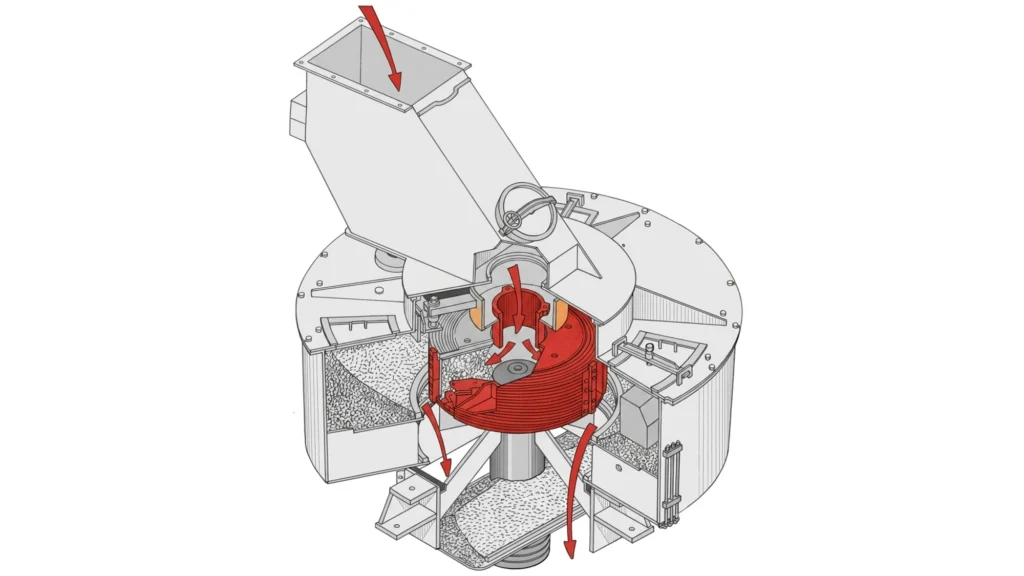
The principle of these machines is close to that of a centrifugal pump. The grains to be thrown are fed near the centre of a table crossed by channels running from the centre to the periphery.
Under centrifugal force, the grains move towards the outside of the table, leave it and begin a flight path. They then strike either wear plates or a bed formed of the product itself.
At the start of this path, the speed of the grain results from two components: its speed relative to the table, and the peripheral speed of the table at the exact point where it leaves. To know the ejection point is therefore to know the trajectory.
The architecture of the rotor
The rotor combines a table and a vertical-axis cylinder turning at high speed. The cylinder has:
- a horizontal circular opening at the top, through which material enters by gravity;
- peripheral side openings at table level, through which it is ejected.
It is the internal arrangement of the rotor that gives the process its whole value.
Autogenous operation: the material protects the machine
How the rock shelf forms
The internal geometry of the rotor creates zones where grains of material are held in place by centrifugal force. These zones therefore fill with material, forming what is known as the rock shelf.
Once the rock shelf has formed, the incoming material rubs against it before being discharged. In other words: material slides on material, not on metal. This contact causes no metal wear, and as the layer wears away it rebuilds itself.
On the rock shelf, the pieces remain in balance on a bed whose angle depends on the material. Their rate of progress depends essentially on the shape of the cone that converts free-fall energy into speed. To move forward, the material must either roll — which concerns only isolated, roughly rounded pieces — or slide with friction, which consumes energy.
The only areas of real wear
This principle keeps the interface between moving material and metal to a minimum. Three areas remain exposed:
- the distributor cone that brings the material up to speed;
- the lip from which the rock shelf builds up;
- the horizontal surfaces, at the top and bottom of the rotor, against which the moving material rubs.
Each undergoes a specific type of wear, which makes it possible to choose a suitable material for each. The cone, which converts free fall into speed, must be very hard to resist abrasion.
The discharge edge, from which the rock shelf builds up, is a special case: the contact there is friction free of impact. The material of choice is then tungsten carbide, in the form of a very localised insert. Its hardness is decisive, its low resilience of no consequence — provided the edge is protected by a ductile support, in case random rebounds bring it into contact with ejected pieces.
This protection can be provided by cast iron parts arranged along the generatrices of the rotor, just ahead of the discharge openings, where they act as occasional impact pieces.
Fragmentation by impact
An essential point, often misunderstood: at this stage no fragmentation has yet taken place. The rotor has done nothing more than impart speed to the projectiles. The whole question then becomes how best to manage that energy.
Projectiles and targets
To avoid wear, the projectiles are received not by metal but by an annular bed of material, which forms a slope on a circular lip concentric with the rotor axis.
The cycle is as follows: the projectiles meet the stator, dissipate their energy there, come to rest, then slump — becoming in turn the targets of the following projectiles. The meeting of near-stationary targets and fast projectiles produces the fragmentation. The fragmented material is then discharged through the lower part of the crusher.
Why throughput governs efficiency
This is a direct consequence of the principle, and it has concrete implications in operation.
If the machine is stopped and the bed examined, it is found to be loose, made up mostly of fines: the pieces of any size have slumped away. At low throughput, impacts are therefore not very effective, for want of sufficiently massive targets. A sustained throughput is needed for the bed to stay stocked with genuinely crushable pieces.
To this must be added the range of particle sizes among the projectiles. There is generally no very fine material, but small, medium and large projectiles, each carrying energy in proportion to its mass. The targets show the same range. The effectiveness of each impact therefore varies with the contact conditions and the size distribution on either side.
Results and applications
Exceptional cubicity
The VSI produces aggregates of excellent shape, with a flakiness index of around 5. This is its major contribution: it considerably enhances the output of the crushers upstream in the plant.
This quality of shape is decisive for aggregates intended for concrete and road works, where flakiness directly governs the compaction and durability of the final material.
The reasonable maximum feed particle size is 45 mm. The VSI therefore sits downstream in a crushing circuit, as a finishing stage, and not at the head of a plant.
Wear cost and abrasiveness
How the wear cost develops depends on the abrasiveness of the material processed, and particularly on its silica content. This is the first parameter to examine when sizing a plant.
Wear parts are replaced quickly under normal economic conditions, which preserves the availability of the plant.
Crusher and screen: an inseparable pair
A VSI cannot be considered in isolation. The crusher and screen together should be regarded as a single crusher fitted with a very precise adjustment parameter.
From this follows a simple design rule: the reduction achieved between inlet and outlet must be as high as possible. This is what limits both the energy consumption and the consumption of wear material. A poorly sized circuit, which recirculates material needlessly, is paid for on both counts at once.
When to choose a vertical shaft impact crusher
The VSI is the obvious choice when the shape of the aggregate comes first — production of quality sand, aggregates for concrete, wearing courses. It does not replace a primary or secondary crusher: it enhances their output.
Three factors guide the sizing: the feed particle size, which must stay below 45 mm, the silica content of the material, which governs the wear cost, and the throughput of the plant, on which the effectiveness of the impact itself depends.
WEIL Brechertechnik designs and manufactures in Germany vertical shaft impact crushers with an autogenous rotor. Discover the WEIL vertical shaft impact crushers and their detailed technical specifications.